
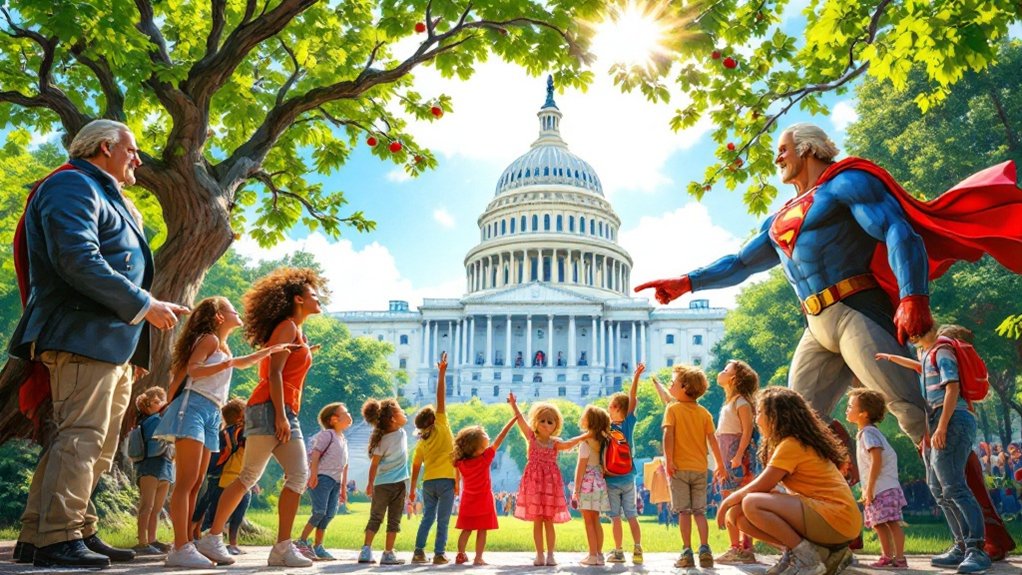
Have you ever heard the story about George Washington and his cherry tree? It’s a classic, but it raises some questions about truth and legend. What about the spooky tales surrounding D.C.’s monuments? Or the mystery of the missing 13th floor in buildings? Each myth has its own story, waiting for you to uncover. Let’s explore these intriguing tales and see what’s real and what’s simply a captivating fabrication.
The Cherry Tree Story: Fact or Fiction?

Have you ever wondered if the famous cherry tree story about George Washington is true? This tale, where young George supposedly confesses to chopping down a cherry tree, is often told to illustrate his honesty.
However, historians largely consider it a myth. The story first appeared in the biography by Mason Locke Weems, published years after Washington’s death. Weems aimed to create a moral lesson rather than provide a factual account.
While it’s a charming story, it’s essential to remember it’s more folklore than history. So, next time you hear about Washington and the cherry tree, you can confidently share that it’s likely just a tale meant to inspire honesty, not a true event in the life of our first president.
The 13th Floor Myth: Why D.C. Buildings Skip It
You might be surprised to learn that many buildings in Washington, D.C., skip the 13th floor altogether. This isn’t just a quirky architectural choice; it’s tied to superstitions. Many people believe the number 13 brings bad luck, so developers often skip it to attract tenants and avoid negative connotations.
Instead, they label the 14th floor as the 13th, creating a seamless transition that keeps everyone happy.
In a city filled with history and tradition, this practice helps maintain the allure of these buildings. Next time you’re in D.C., keep an eye out for those missing floors. You’ll have a fun story to tell about how superstition shapes the city’s skyline!
Lincoln’s Chair Myth: The Truth Behind the Legend?
While many visitors to the Lincoln Memorial admire the grandeur of the statue, few know about the myth surrounding the chair he’s depicted sitting in. Some believe it’s a replica of the original chair in which Lincoln sat while addressing Congress.
However, that’s not true! The chair was actually designed specifically for the memorial and isn’t a historical artifact.
This myth likely grew because the chair’s design reflects Lincoln’s dignity and strength. The statue itself is a powerful representation, but it doesn’t connect directly to actual furniture from his time.
The True Color of the White House
Although many people envision the White House as a pristine white structure, its true color has a fascinating history.
When it was first built, the White House was made from Aquia Creek sandstone, which had a grayish hue. After construction, it was painted a light color using a mixture of lime, casein, and water to protect the stone.
Over time, smoke and weathering darkened the exterior, and in 1818, President James Monroe ordered a new coat of whitewash to brighten it up, leading to its current appearance.
This iconic color wasn’t just for looks; it also helped preserve the building.
The Haunted Myths of D.C. Monuments
As you stroll through Washington, D.C., it’s hard not to feel a tingle of intrigue surrounding the city’s monuments, especially with tales of hauntings lingering in the air.
The Lincoln Memorial, for instance, is rumored to host the ghost of its namesake, appearing on moonlit nights.
Meanwhile, visitors at the White House have reported eerie encounters, claiming they’ve seen shadows moving through the halls.
Don’t forget the National Gallery of Art, where some say they’ve felt a chill, attributing it to the spirit of a long-gone artist.
These stories blend history with the supernatural, sparking your imagination.
Conclusion
So there you have it! You’ve uncovered the truth behind some of D.C.’s most famous myths. Whether it’s the cherry tree story or the mysteries of the 13th floor, you’ve learned that history isn’t always what it seems. Next time you’re exploring the city, remember these tales and share your newfound knowledge. Who knows? You might just inspire a friend to question what they thought they knew about D.C. history!